Practical Support for Worship Singers & Teams
Worship ministry places real demands on real people.
Many singers serve faithfully while balancing work, family, health, and limited preparation time. This page contains a collection of free tools designed to support worship singers and teams in their growth and preparation.
Here you’ll find free practical resources, vocal exercises, and helpful guides to help you grow in skill, confidence, and unity so you can serve effectively in rehearsals, services, and everyday life.
These resources reflect the heart of TheKenaniah Method ™ — supporting musicians who sing, individual singers, and entire teams — to develop skillful singing, a voice prepared for purpose, and authentic worship.
New to worship teams? This guide will help you feel at home quickly.
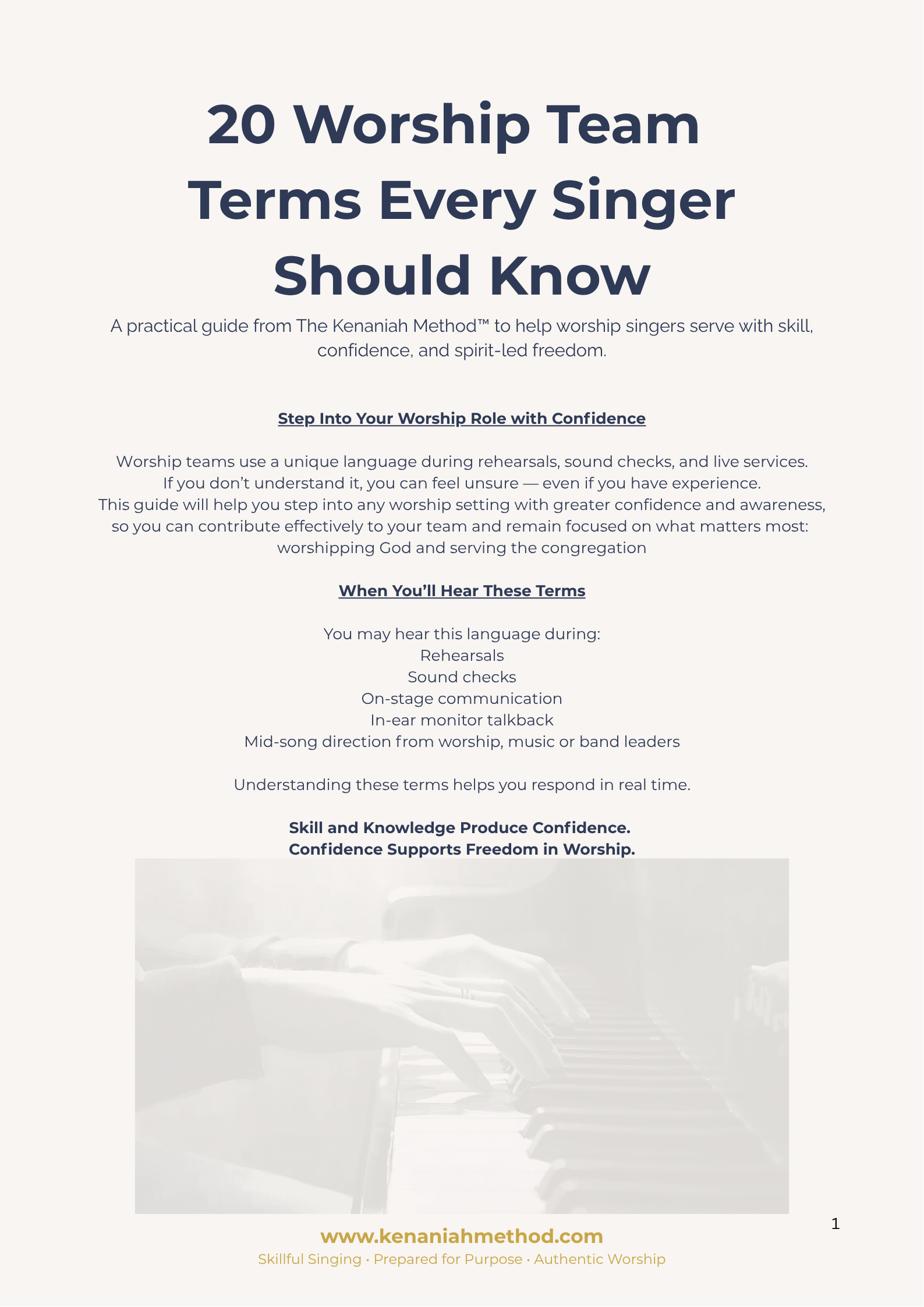
20 Worship Team Terms Every Singer Should Know
Feel confident in rehearsals, sound checks, and live services — even if you’re new to worship teams.
Worship teams use a language that isn’t always explained. When you don’t know what , you can feel unsure or out of place.
This practical guide will help you:
✔ Understand common worship team terminology
✔ Respond confidently to real-time direction
✔ Improve communication with leaders and musicians
✔ Reduce anxiety and feel more at home on the team
✔ Stay focused on serving God and the congregation
Whether you’re preparing to join a team or already singing, this resource will help you sing
Because confident singers serve more freely.
No sign-up required.
Transforming Rostered Singers into Prepared, Purpose-Filled Singers
A simple, repeatable system for worship singers who want to feel more vocally consistent and confident — even with limited time.
You love serving on your worship team, but between work and life, it’s easy to feel:
vocally inconsistent
unsure of your voice
frustrated that your voice doesn’t sound the way you want
This guide gives you a simple system to follow — even when you’re busy.
Instead of guessing what to do between Sundays, you’ll know exactly:
how to use the time you already have
what to focus on when practicing
how to develop consistency without pressure
Vocal Exercises for Worship Singers
These YouTube exercises are designed to help worship singers warm up their voice, develop better vocal control, and build confidence in their singing.
You can use them as part of your personal practice routine or as a quick warm-up before rehearsal or a service.
Each exercise focuses on practical skills that help worship singers develop skillful singing, a voice prepared for purpose, and authentic worship.
WARM UP EXERCISE
INSTRUCTION:
This version is in a flexible A-to-A range so it can be used by a wide variety of voices.
Sing in the octave that feels comfortable for your voice
Breathe wherever you need to
Use vowel tones Ay, Ee, Ah, Oh, Oo.
AGILITY EXERCISE
INSTRUCTION:
Set at 120 BPM, this exercise is designed to develop vocal consistancy and pitch accuracy while moving quickly between intervals.
Breathing needs to be quick and efficient to support the pace of the exercise. ("Breathe" cues and vowel tones are noted at the start of the clip to help guide your breathing.) Once familiar, aim to keep it consistant throughout the track.
This version covers the vocal range of E3–F4, making it suitable for a wide variety of voices.
This exercise works well for:
• building agility for faster, energetic songs
• improving interval accuracy
• developing fast, controlled breathing
PERFECT PITCH EXERCISE
INSTRUCTION:
This exercise helps worship singers develop pitch awareness and vocal accuracy by training the ear to hear and match a sustained reference tone.
This version moves through the vocal range from A to C, so it can be used by a wide variety of voices.
Breathe in between each vowel tones and hear how your breath connects to your sound.
Focus on "listening" as your voice matches the drone.
When your pitch aligns, you'll "feel" the frequencies lock together... that is accurate pitch.
BREATHING EXERCISE
INSTRUCTION:
This exercise is designed to help worship singers develop breath control, while singing a melodic pattern that covers a large range.
("Breathe" cues are noted at the start of the clip to help guide your breathing. Once familiar, aim to keep it consistant throughout the track.)
This version moves from A-to-E vocal range so it can be used by a wide variety of voices. This exercise will help:
• building breath support for longer phrases
• develop consistency across your range
• smooth transitions through your range